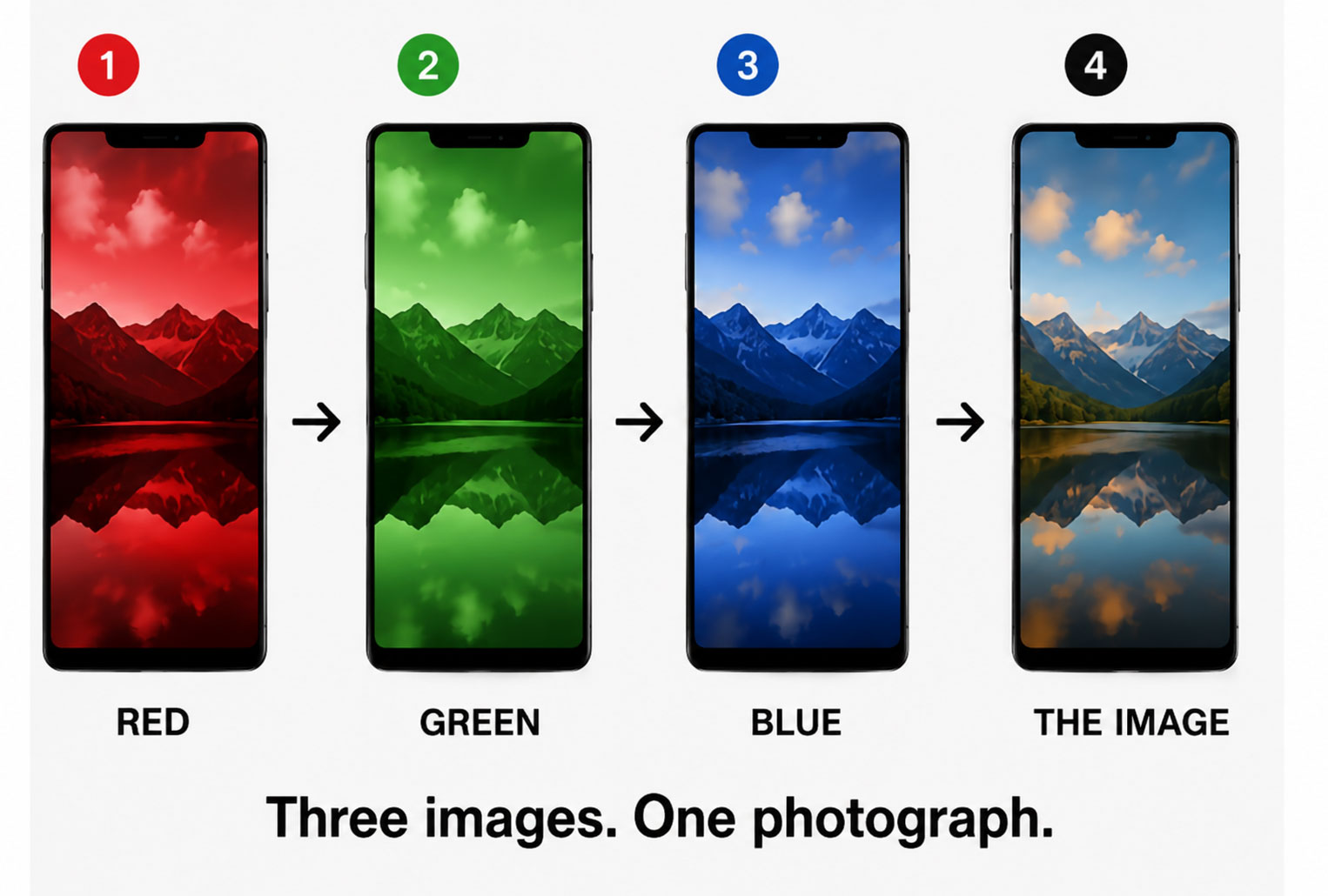
Tri-colour photography is an early colour photography process: a scene is photographed three times – through red, green and blue filters respectively. This produces three black-and-white colour separations, which are then combined to form the colour image either additively (by superimposing red, green and blue light) or subtractively (e.g. as cyan, magenta and yellow separations in colour printing).
Historically, the demonstration by James Clerk Maxwell and the photographer Thomas Sutton in 1861 is regarded as a key starting point: three filtered images were projected and superimposed. However, to achieve results suitable for everyday use, better filters and, above all, panchromatic emulsions were required.
Applications were found early on in science and documentation, in reproduction photography, and in printing and projection technology (colour slides/‘colour transparencies’ from three prints).
Adolf Miethe, Professor of Photochemistry in Berlin, made decisive advances in the process around 1900: he improved the sensitisation of photographic plates, optimised reproduction using three-colour projection, and, together with the camera manufacturer Wilhelm Bermpohl, had a three-colour camera built, which was even commercially available by around 1903.
Among the first photographs published using this three-colour camera were colour prints from specialist journals dating from 1903, some of which were based on photographs taken in September 1902. The three individual images were arranged on a single strip of film (e.g. 9×24 cm); the exposure times for each colour channel were in the range of a few seconds. Consequently, still lifes, architecture and landscapes were initially the most suitable subjects – as colour fringing easily occurred with moving subjects. Later, Sergei Prokudin-Gorsky also used this principle for extensive colour documentation.